Brain-Computer Interfaces (BCI) with Deep Learning
Introduction: What is a Brain-Computer Interface?
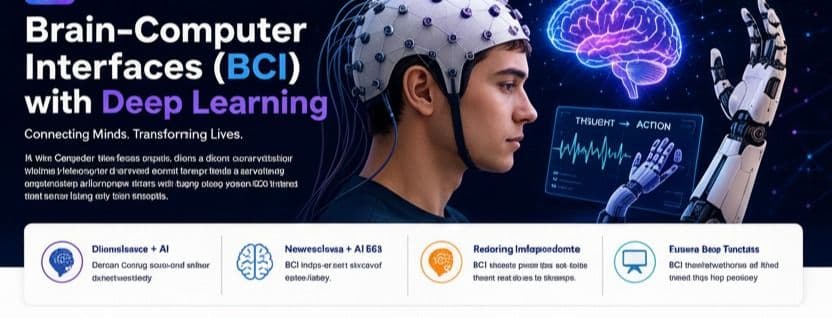
A Brain-Computer Interface (BCI) is a revolutionary technology that creates a direct communication pathway between the brain and external devices. By capturing electrical signals generated by neural activity, processing them through sophisticated algorithms, and translating them into commands, BCIs enable people to interact with computers, robotic limbs, wheelchairs, and other devices using only their thoughts.
This technology holds transformative potential, particularly for individuals with paralysis, ALS, stroke, or spinal cord injuries-offering them new pathways to independence and communication.
How the Brain Produces Electrical Signals
The human brain contains approximately 86 billion neurons that communicate through tiny electrical impulses. When neurons fire together in response to thoughts, movements, or sensory input, they produce measurable patterns of electrical activity.
Understanding EEG (Electroencephalography)
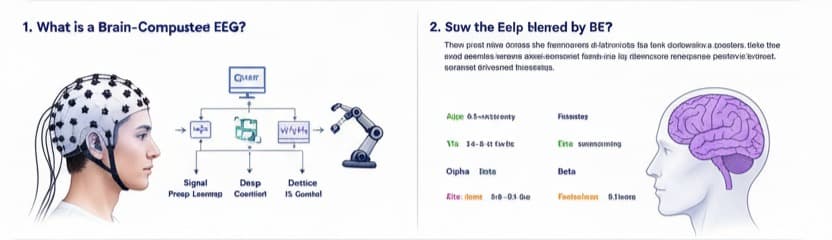
Electroencephalography (EEG) is the most widely used non-invasive method for capturing brain signals in BCI systems. Here's how it works:
- Electrodes are placed on the scalp (typically 16-64 channels).
- These electrodes detect voltage fluctuations from ionic current flows within neurons.
- The signals are amplified and digitized for processing.
- EEG offers high temporal resolution (millisecond precision) but lower spatial resolution.
Types of Brain Computer Interfaces
BCIs are classified based on how brain signals are acquired:
- 1. Non-Invasive (EEG, NIRS):
- Sensors placed outside the skull.
- Safest approach with no surgical risk.
- Lower signal resolution.
- Most practical for consumer and research applications.
- 2. Semi-Invasive (ECOG):
- Electrodes placed on the brain surface (under the skull).
- Better signal quality than EEG.
- Reduced surgical risk compared to fully invasive.
- 3. Invasive (Implants):
- Electrodes implanted directly into brain tissue.
- Highest signal accuracy and resolution.
- Used in medical applications (e.g., Neuralink, Utah Array).
The BCI System Pipeline
A complete BCI system follows this workflow:
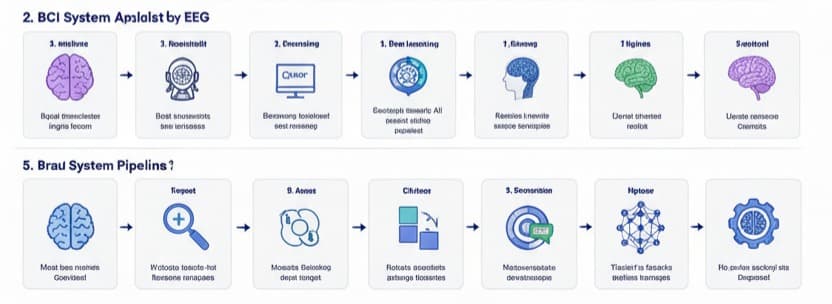
- 1. Acquisition: EEG cap collects raw brain signals.
- 2. Preprocessing: Remove noise, filter artifacts, normalize data.
- 3. Segmentation: Divide continuous signals into time windows (epochs).
- 4. Feature Extraction: Extract spatial, spectral, or time-frequency features.
- 5. Deep Learning Model: CNN/LSTM/Transformer learns patterns.
- 6. Decoding: Model predicts the user's intention.
- 7. Output/Action: Control external device or application.
Deep Learning for BCI: Why It Works
Traditional BCI systems relied on hand-crafted features and classical machine learning. Deep learning has revolutionized this field by:
- Automatically learning hierarchical features from raw EEG signals.
- Achieving higher accuracy in decoding brain intentions.
- Reducing the need for manual feature engineering.
- Handling the complexity of multi-channel, time-series brain data.
Key Deep Learning Architectures for EEG
| Architecture | Strength | Use Case |
|---|---|---|
| CNN | Captures spatial patterns across electrodes | Motor imagery classification |
| LSTM/RNN | Models temporal dependencies in sequences | Continuous signal decoding |
| Transformer | Attention mechanism for long-range relationships | Complex cognitive states |
CNN Architecture for EEG Classification
Here's a practical implementation of a Convolutional Neural Network for motor imagery classification using PyTorch:
import torch
import torch.nn as nn
import torch.nn.functional as F

class EEG_CNN(nn.Module):
    # CNN for EEG Motor Imagery Classification
    # Input shape: (batch_size, channels, time_samples)
    # Example: (32, 64, 256) - 64 EEG channels, 256 time points

    def __init__(self, n_channels=64, n_timepoints=256, n_classes=4):
        super(EEG_CNN, self).__init__()

        # Temporal convolution - learns temporal patterns
        self.conv1 = nn.Conv2d(1, 32, kernel_size=(1, 25), padding=(0, 12))
        self.bn1 = nn.BatchNorm2d(32)

        # Spatial convolution - learns spatial patterns across electrodes
        self.conv2 = nn.Conv2d(32, 64, kernel_size=(n_channels, 1))
        self.bn2 = nn.BatchNorm2d(64)

        # Additional convolution layers
        self.conv3 = nn.Conv2d(64, 128, kernel_size=(1, 10), padding=(0, 5))
        self.bn3 = nn.BatchNorm2d(128)

        self.pool = nn.AvgPool2d(kernel_size=(1, 4))
        self.dropout = nn.Dropout(0.5)

        # Calculate flattened size
        self._to_linear = self._get_conv_output((1, n_channels, n_timepoints))

        # Fully connected layers
        self.fc1 = nn.Linear(self._to_linear, 256)
        self.fc2 = nn.Linear(256, n_classes)

    def _get_conv_output(self, shape):
        """Helper to calculate flattened size after convolutions"""
        x = torch.zeros(1, *shape)
        x = self.pool(F.relu(self.bn1(self.conv1(x))))
        x = self.pool(F.relu(self.bn2(self.conv2(x))))
        x = self.pool(F.relu(self.bn3(self.conv3(x))))
        return x.numel()

    def forward(self, x):
        # Add channel dimension: (batch, channels, time) -> (batch, 1, channels, time)
        x = x.unsqueeze(1)

        # Convolutional blocks
        x = self.pool(F.relu(self.bn1(self.conv1(x))))
        x = self.pool(F.relu(self.bn2(self.conv2(x))))
        x = self.pool(F.relu(self.bn3(self.conv3(x))))

        # Flatten and classify
        x = x.view(x.size(0), -1)
        x = self.dropout(F.relu(self.fc1(x)))
        x = self.fc2(x)
        return x

# Example usage
model = EEG_CNN(n_channels=64, n_timepoints=256, n_classes=4)
print(f"Model parameters: {sum(p.numel() for p in model.parameters()):,}")

# Sample input (batch of 32, 64 channels, 256 time points)
sample_input = torch.randn(32, 64, 256)
output = model(sample_input)
print(f"Output shape: {output.shape}") # (32, 4) - 4 class probabilities
Applications of Brain-Computer Interfaces (BCI)
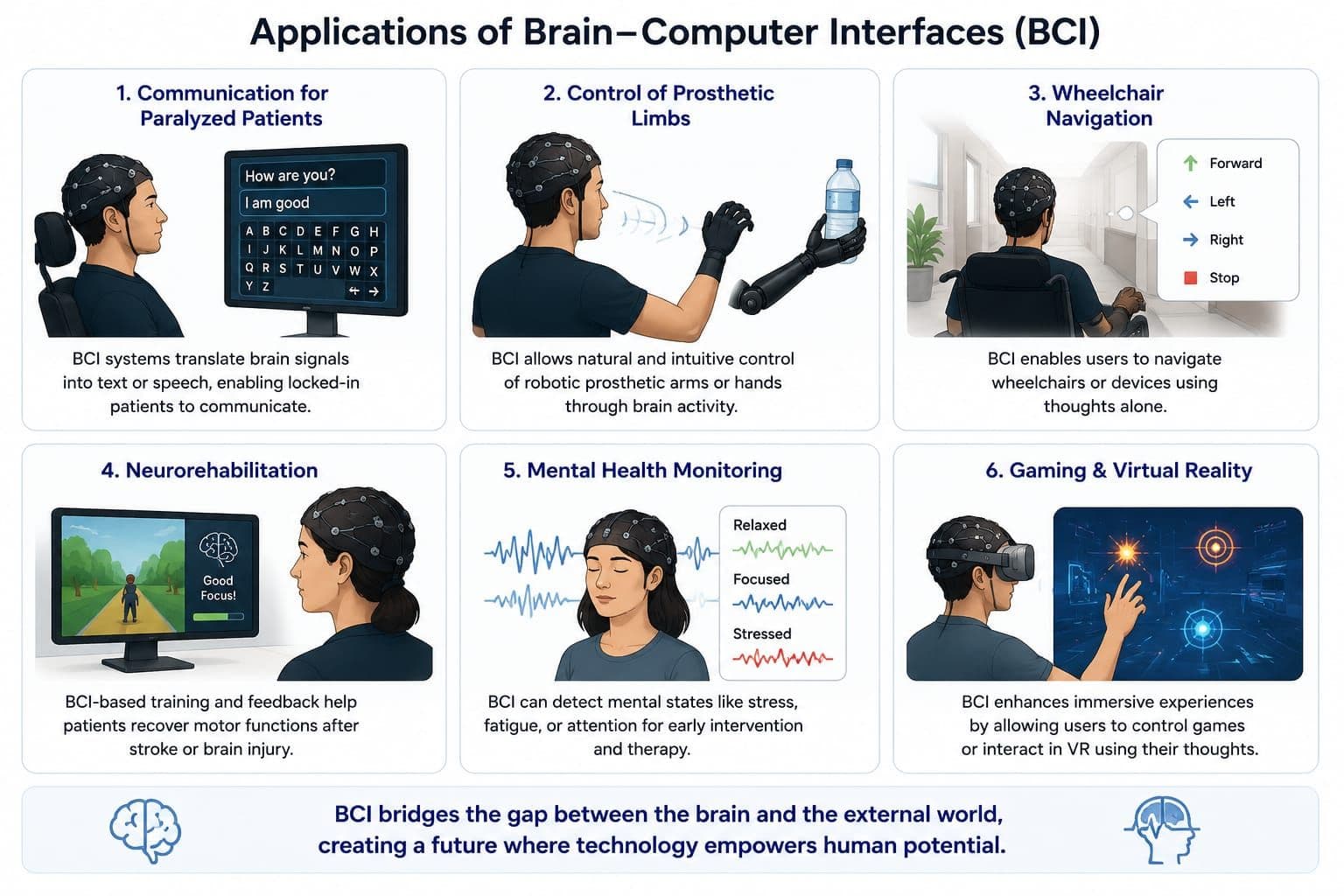
- 1. Communication for Paralyzed Patients: BCI systems translate brain signals into text or speech, enabling locked-in patients to communicate.
- 2. Control of Prosthetic Limbs: BCI allows natural and intuitive control of robotic prosthetic arms or hands through brain activity.
- 3. Wheelchair Navigation: BCI enables users to navigate wheelchairs or devices using thoughts alone.
- 4. Neurorehabilitation: BCI-based training and feedback help patients recover motor functions after stroke or brain injury.
- 5. Mental Health Monitoring: BCI can detect mental states like stress, fatigue, or attention for early intervention and therapy.
- 6. Gaming & Virtual Reality: BCI enhances immersive experiences by allowing users to control games or interact in VR using their thoughts.
BCI bridges the gap between the brain and the external world, creating a future where technology empowers human potential.
Current BCI Devices
| Device | Type | Application |
|---|---|---|
| Neuralink N1 | Invasive | Medical, research |
| Synchron Stentrode | Semi-invasive | Paralysis treatment |
| Emotiv EPOC X | Non-invasive | Research, gaming |
| OpenBCI Ultracortex | Non-invasive | Research, DIY projects |
| Kernel Flow | Non-invasive | Brain mapping |
Challenges in BCI Development
- Low Signal-to-Noise Ratio: Brain signals are weak and easily contaminated.
- Inter-subject Variability: Signals differ significantly across individuals.
- Need for Large Labeled Datasets: Deep learning requires substantial training data.
- Real-time Processing: Latency must be minimized for practical applications.
- Ethical and Privacy Concerns: Brain data is highly sensitive.
The Future of BCI
The field is rapidly advancing toward:
- Higher accuracy with advanced deep learning models.
- Wearable and wireless EEG devices for everyday use.
- Neural implants for high-bandwidth communication.
- Integration with AI, IoT, AR/VR, and robotics.
- A future where thoughts seamlessly interact with technology.
Resources & Datasets
Open Datasets for BCI Research:
- BCI Competition IV 2a/2b: Motor imagery datasets.
- EEGMMIDB: 109-subject motor imagery dataset.
- PhysioNet: Various EEG datasets.